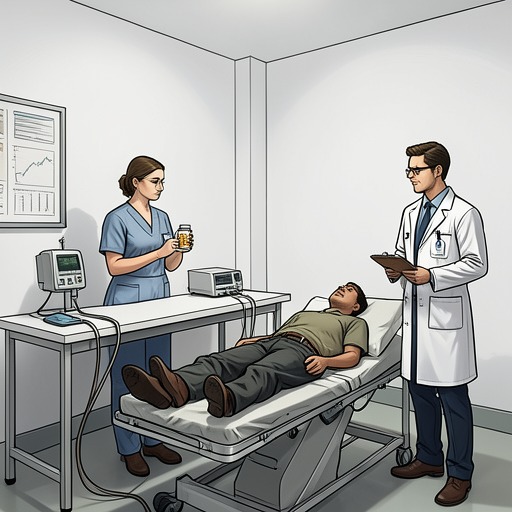
Tub room
One Flew Over the Cuckoo's NestThe Tub room is a disused hydrotherapy space that becomes a second gathering place for the ward’s patients. Its transformation is incomplete: card games and conversation occupy the room, but an unused chrome control panel and its surrounding nozzles preserve the threat of the treatment for which the space was built.
Setting and Original Function
The room had been designed for hydrotherapy, but the ward no longer used it for that purpose after the introduction of new drugs. Tables were stored there during ward meetings, and otherwise the room stood unused. Its obsolete clinical function nevertheless remained visible in the equipment: a steel control panel, chrome fittings, and nozzles arranged around a square tiled booth.
Chief Bromden connects this apparatus to an earlier hospital’s hydrotherapy treatment. He recalls a technician in a rubber apron manipulating the controls to direct water at different parts of a patient’s body, varying its temperature and force. Patients were held in canvas straps under the spray, left soaked and limp. The memory gives the supposedly idle equipment a history of bodily restraint and institutional control.
A Second Gathering Place
When noise from the radio made it difficult for some patients to read, Dr. Spivey proposed using the old Tub room as a second day room or game room. He presented the idea as a way to give patients seeking quiet a place apart from those who wanted to listen to the radio. Nurse Ratched objected that the ward lacked staff to supervise another room, but the proposal identified a new communal use for a space that had been set aside and forgotten.
The Tub room later holds card games, including poker and blackjack. After the patients refuse to vote with Randle Patrick McMurphy, he wins so heavily at cards that they become reluctant to risk more money. Nurse Ratched also has their cigarette cartons kept at the Nurses’ Station and distributes one pack per day, a policy she presents as being for their health. With gambling curtailed and the cards gone, the room becomes unusually quiet; the sound from the day room and a patient calling from the Disturbed Ward carry into it.
Play, Resistance, and the Escape Screen
The room’s patients turn its clinical fittings into material for play. Mr. Martini pretends to pilot a jet from behind the hydrotherapy panel, spinning a dial and pushing a lever while the controls activate no water. The equipment is brand new, yet it has never been used. His game makes the panel briefly serve an imagined machine rather than a real treatment apparatus, even as its function remains unmistakable.
The Tub room also becomes a setting for McMurphy to test the limits of the ward’s security. After hearing that the window screens are specially made and resist blows from a chair, he considers what would be heavy enough to break one. He does not carry out an escape attempt in this discussion; instead, he challenges the others to imagine that the barrier could be overcome if he decided to try. The talk brings the room’s informal gathering life into contact with the possibility of leaving the institution.
Significance
The Tub room is defined by the contrast between its former and present uses. A space built for controlled treatment becomes a place for games, conversation, and speculation, but the old apparatus remains in view, linking recreation to the ward’s capacity to restrain and manage its patients. Its makeshift communal life is also vulnerable to institutional rules: cigarette rationing and the patients’ debts drain the card games of energy. The room offers a measure of shared space without ceasing to belong to the system that governs the ward.